
Chevy Transfer Case Interchange Chart: Compatibility & Swap Guide
Finding the right replacement transfer case for your Chevrolet Silverado or GMC Sierra can feel like navigating a maze of spline counts, drop sides, and electronic shift modules.
One wrong choice at the salvage yard can leave you with a heavy piece of cast iron or aluminum that simply won’t bolt up to your transmission.
To simplify your swap, a Chevy Transfer Case Interchange Chart acts as the ultimate compatibility blueprint. It reveals that units like the manual NP241 and electronic NP246 or NP261 can often swap within their respective truck generations, provided they share the same input shaft spline count (typically 27, 29, or 32), drop-side configuration, and shift mechanism.
Before turning a single wrench, remember that mismatched spline counts and drop orientations account for nearly 80% of failed DIY swap attempts. This comprehensive guide breaks down every major Chevy transfer case model, provides a year-by-year interchange matrix, and explains how to successfully execute a swap without unexpected driveline headaches.
Key Takeaways
- Input shaft spline count (27-spline for 4L60E, 32-spline for 4L80E/Allison, 29-spline for manual transmissions) is the primary mechanical barrier to interchangeability.
- Chevy transitioned from passenger-side drop (older solid axle K-series) to driver-side drop (IFS trucks starting in 1988), which dictates front differential alignment.
- The round metal ID tag on the rear case half (New Process, New Venture, or Magna Powertrain) is the most reliable way to identify your specific model and ratio.
- Swapping a manual transfer case (like the NP261) for an electronic version (like the NP263) requires extensive wiring harness and Transfer Case Control Module (TCCM) retrofitting.
- Common swap hurdles such as clocking angles, sensor differences, and slip yoke configurations must be addressed before finalizing any installation.
What transfer cases are interchangeable on Chevy trucks?
Chevy transfer cases are interchangeable if they share the same platform generation, matching transmission output shaft spline counts, front-differential drop orientation, and electronic shift systems.
While physical bolt patterns are often identical, swapping across generations or transmission types usually requires changing the input gear or modifying the wiring harness.
The Rules of Chevy Transfer Case Interchangeability
To successfully swap a transfer case in a Chevrolet or GMC truck, you must match three critical interfaces: mechanical, electrical, and physical geometry.
- Transmission Spline Count: The transfer case input shaft must match the transmission output shaft. Half-ton trucks with light-duty automatic transmissions (like the 4L60E) typically use a 27-spline configuration. Heavy-duty trucks equipped with the 4L80E transmission use a 32-spline setup.
- Heavy-Duty Spline Variations: Chevy heavy-duty trucks from 2001 to 2007 with the Duramax diesel or 8.1L gas engine utilize a 29-spline input shaft on NP261XHD and NP263XHD transfer cases. This unique configuration makes them non-interchangeable with standard 1500 or 2500LD 32-spline units unless you perform a complete input shaft swap.
- Drop Orientation: The front-differential output (drop) must exit on the correct side of the vehicle. For example, the NP241C transfer case is highly sought after for solid axle swaps because it was produced in both passenger-side drop (pre-1991) and driver-side drop (1988-up) configurations. Mixing these up will leave you with a front driveshaft that cannot connect to the front axle.
- Shift Control Systems: Swapping a manual floor-shift transfer case (like an NP241 or NP261) into a truck wired for an electronic push-button system (like an NP243 or NP263) requires extensive wiring modifications or physical linkage fabrication.
Understanding Chevy Transfer Case Families
Chevy trucks are categorized by platform generations, and transfer cases generally swap most easily within these distinct families.
GMT400 Generation (1988–2000): This era relies heavily on New Process Gear (NPG) units, specifically the NP241C (manual), NP243 (electric shift), and the early NP246 Autotrac (active automatic 4WD).
These transfer cases use a standard 6-bolt circular mounting pattern, but early models use mechanical speedometers while later versions utilize electronic vehicle speed sensors (VSS).
GMT800 Generation (1999–2007): This generation refined the NP246 Autotrac and introduced the heavy-duty NP261 (manual) and NP263 (electric) series. Physical mounting remains similar to the GMT400, but the electronic integration, shift modules, and communication protocols are entirely different, preventing direct plug-and-play electronic swaps between these generations.
GMT900 Generation (2007–2014): General Motors transitioned to Magna Powertrain (MP) units, such as the MP3023 (active) and MP3024 (two-speed manual/electric). These units are highly integrated into the truck’s CAN-bus computer network.
Swapping these requires exact matching of the internal encoder motor and the truck’s Transfer Case Control Module (TCCM) to avoid diagnostic trouble codes and disabled 4WD systems.
| Platform Generation | Common Transfer Cases | Standard Spline Counts | Front Output (Drop) Side |
|---|---|---|---|
| GMT400 (1988–2000) | NP241C, NP243, NP246 | 27-spline (Half-ton), 32-spline (Heavy-duty) | Driver-side (standard); Passenger-side (pre-1991 K-Series) |
| GMT800 (1999–2007) | NP246, NP261, NP263 (HD/XHD) | 27-spline (1500), 32-spline (2500LD), 29-spline (Duramax/8.1L) | Driver-side |
| GMT900 (2007–2014) | MP3023, MP3024 | 31-spline, 36-spline | Driver-side |
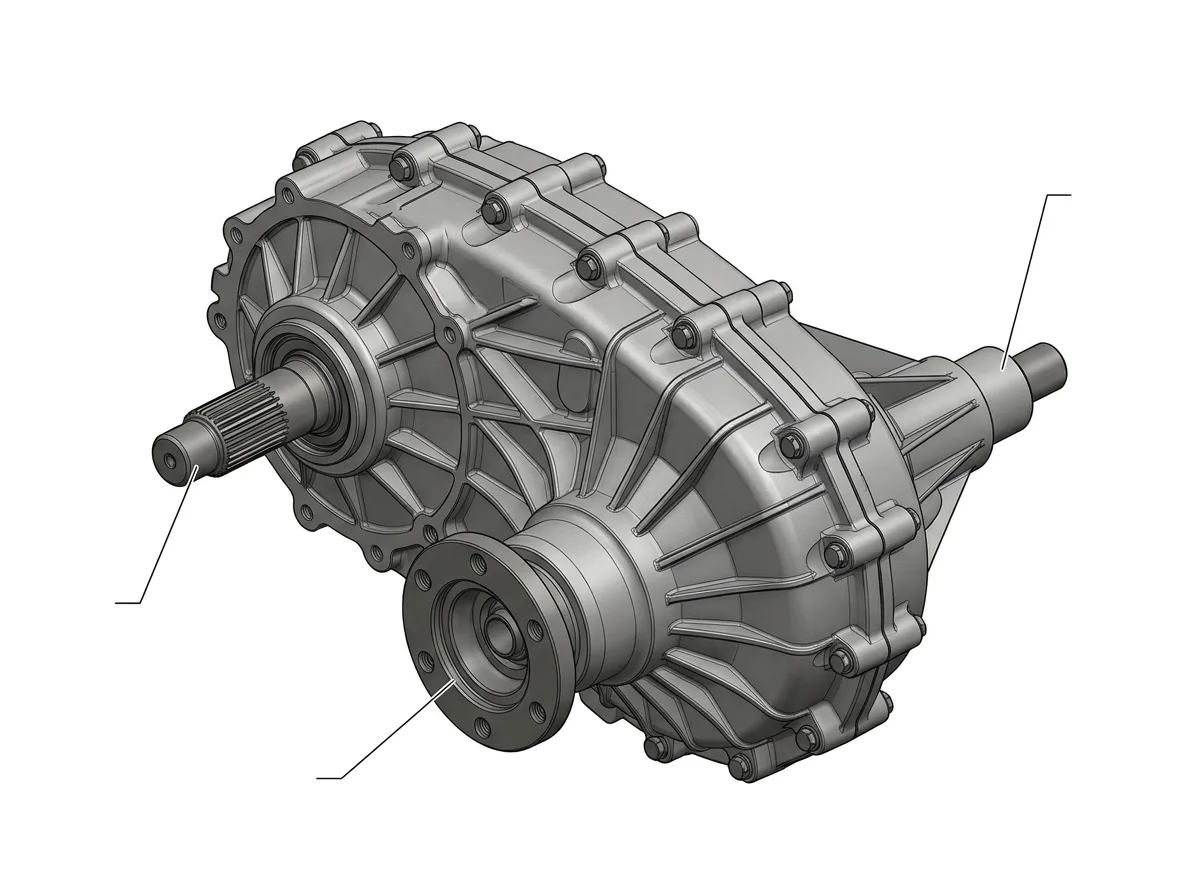
Key factors for Chevy transfer case compatibility
To determine if a Chevy transfer case will swap directly into your truck or SUV, you must match four critical mechanical constraints: input shaft spline count, front differential drop side, transmission tailhousing bolt pattern, and the shift engagement system.
If any of these specifications differ between your donor and recipient vehicles, the transfer case will not bolt up or function without extensive modification.
Transmission Output and Input Shaft Spline Matching
The transmission output shaft must slide perfectly into the transfer case input shaft. General Motors used several different spline counts depending on the engine, transmission, and model year.
For example, light-duty trucks equipped with the 4L60E transmission typically use a 27-spline connection, while heavier-duty applications with the 4L80E use a 32-spline connection.
Heavy-duty configurations introduce even more specific constraints. Chevy heavy-duty trucks from 2001 to 2007 with the Duramax diesel or 8.1L gas engine utilize the 29-spline input shaft on NP261XHD and NP263XHD transfer cases.
This 29-spline configuration makes these heavy-duty units completely non-interchangeable with standard 1500 and 2500 light-duty 32-spline units unless you physically swap the input gear inside the transfer case.
Front Axle Output Alignment (Drop Side)
The front driveshaft must align with your front axle’s differential. GM vehicles use either a “passenger-side drop” (where the front driveshaft exits on the passenger side) or a “driver-side drop.” Putting a driver-side drop transfer case into an older passenger-side drop vehicle is physically impossible without custom axle fabrication.
This layout variance makes certain vintage models highly desirable for custom builds. The NP241C transfer case is highly sought after for solid axle swaps because it was produced in both passenger-side drop (pre-1991) and driver-side drop (1988-up) configurations.
Choosing the correct model year ensures your driveshaft lines up perfectly with your front differential.
Shift Control Systems and Case Indexing
Finally, you must match the shift control mechanism. You cannot easily swap a manual floor-shifted transfer case (like an NP241C or NP261) with an electronic push-button or Autotrac unit (like an NP243 or NP246) because the vehicle’s wiring harness, Engine Control Module (ECM), and instrument cluster are hardwired for a specific system.
Additionally, ensure the circular mounting bolt pattern on the transmission adapter matches. While GM standard-duty transmissions use a common 6-bolt round pattern, the clocking (the angle at which the transfer case hangs) can vary between trucks and SUVs, which can cause floorboard or frame clearance issues.
| Transfer Case Model | Common Input Spline Counts | Drop Side Options | Shift Control Type |
|---|---|---|---|
| NP241C | 27-spline, 32-spline | Passenger-side (pre-1991) / Driver-side (1988-up) | Manual Floor Shift |
| NP261XHD | 29-spline (Duramax / 8.1L) | Driver-side | Manual Floor Shift |
| NP263XHD | 29-spline (Duramax / 8.1L) | Driver-side | Electronic Push-Button |
| NP246 (Autotrac) | 27-spline, 32-spline | Driver-side | Automatic / Electronic |
Input shaft spline counts: 27, 29, and 32 splines
To determine if a Chevy transfer case will bolt up to your transmission, you must first match the input shaft spline count. Chevrolet and GMC trucks use three primary input shaft configurations—27, 29, and 32 splines—which correspond directly to the strength and duty cycle of the mating transmission.
- 27-Spline Input Shafts: This configuration is the standard for light-duty setups. You will find 27-spline inputs paired with light-duty automatic transmissions, most notably the 4L60E, 700R4, and 4L65E. These are common in half-ton trucks and SUVs like the Silverado 1500, Tahoe, and Suburban.
- 32-Spline Input Shafts: This is the heavy-duty standard for GM automatic transmissions. The rugged 32-spline input is used on heavy-duty gearboxes including the 4L80E, 6L90E, TH400, and the Allison 1000 series found in 2500HD and 3500 series trucks.
- 29-Spline Input Shafts: This count is typically reserved for manual transmissions, such as the heavy-duty NV4500 five-speed. However, there are notable automatic exceptions in the heavy-duty segment.
If you are hunting for parts in a salvage yard, pay close attention to the vehicle’s original engine and transmission package. For example, heavy-duty Chevy trucks from 2001 to 2007 equipped with the Duramax diesel or 8.1L gas engine utilize a 29-spline input shaft on the NP261XHD (manual shift) and NP263XHD (push-button) transfer cases.
Because of this 29-spline configuration, these extra-heavy-duty units will not directly interchange with standard 1500 or 2500LD trucks that use 32-spline inputs, unless you perform an input shaft swap.
Can you swap a transfer case with the wrong spline count? Yes, but it requires work.
Input shafts can be swapped internally to match your transmission’s output shaft. However, this is not an external bolt-on fix; it requires a complete teardown and disassembly of the transfer case to access the main pocket bearing and swap the input gear.
| Input Spline Count | Common Mating Transmissions | Typical Vehicle Applications | Compatibility Notes |
|---|---|---|---|
| 27-Spline | 4L60E, 700R4, 4L65E | Silverado 1500, Tahoe, Yukon, Suburban 1500 | Standard light-duty; cannot handle 4L80E torque without input swap. |
| 29-Spline | NV4500 (Manual), Allison 1000 (Duramax/8.1L automatic applications) | Silverado 2500HD/3500 (2001-2007 Duramax/8.1L) | Found on NP261XHD/NP263XHD; incompatible with standard 32-spline 4L80E units. |
| 32-Spline | 4L80E, TH400, 6L90E, Allison 1000 (standard gas applications) | Silverado 2500LD, 2500HD (6.0L Gas) | Heavy-duty automatic standard; highly desirable for high-horsepower swaps. |
Driver-side vs. passenger-side drop
In four-wheel-drive vehicles, the “drop” refers to the specific side of the vehicle where the front driveshaft exits the transfer case to connect with the front differential.
When planning a Chevrolet transfer case swap, matching the drop side is your first and most critical compatibility checkpoint. If the transfer case output does not align with your front axle’s differential housing, the front driveshaft cannot connect.
Historically, Chevrolet designed its four-wheel-drive systems around two distinct layouts:
- Passenger-Side Drop: Pre-1988 Chevy and GMC pickup trucks (along with K5 Blazers and Suburbans built up to 1991) feature a passenger-side drop. This layout matches the solid front axles used during this era.
- Driver-Side Drop: Beginning in 1988 with the introduction of the GMT400 platform, Chevy transitioned its light-duty trucks to an Independent Front Suspension (IFS). This design shift moved the front differential and the transfer case output to the driver side.
Attempting to swap a passenger-drop transfer case into a driver-drop vehicle—or vice versa—is highly impractical. Doing so requires a massive, expensive front axle conversion to flip the differential location.
For builders tackling solid axle swaps (SAS) on newer trucks, finding the right donor case is key. The New Process NP241C transfer case is highly sought after for solid axle swaps because it was produced in both passenger-side drop (pre-1991) and driver-side drop (1988-up) configurations.
This dual-era production makes the NP241C one of the most versatile gearboxes for custom GM 4×4 builds.
Manual shift vs. electronic shift mechanisms
Choosing between a manual shift and an electronic shift Chevy transfer case comes down to mechanical simplicity versus push-button convenience. Manual shift transfer cases use a physical floor lever connected directly to the transfer case shift fork via a mechanical linkage.
Electronic shift transfer cases rely on an electric encoder motor mounted on the case, which rotates the shift shaft when triggered by a dashboard button or dial.
Electronic shift transfer cases are highly integrated into the vehicle’s onboard electronics. When you press a button to engage 4WD, the transfer case encoder motor, speed sensors, and the Transfer Case Control Module (TCCM) must communicate seamlessly with the Engine Control Module (ECM) and the instrument cluster.
If a single sensor fails or a wire corrodes, the entire system can lock you out of four-wheel drive.
Converting a Chevy truck from an electronic shift to a manual shift transfer case (or vice versa) is incredibly complex. While the physical cases often bolt up to the same transmission face, the wiring harnesses, interior trim, instrument clusters, and computer programming are completely different.
A manual conversion requires sourcing the physical floor shifter, cutting the transmission tunnel, and bypassing the TCCM to prevent dashboard error lights. Converting a manual truck to electronic shift is rarely practical, as it requires installing a custom wiring loom, the TCCM, dashboard switches, and reprogramming the vehicle’s computer network.
For most builders, it is far more cost-effective to swap like-for-like shift mechanisms.
Chevy transfer case interchange chart by model
A Chevy transfer case interchange chart serves as a direct compatibility map showing which four-wheel-drive transfer cases can swap between different Chevrolet and GMC trucks, SUVs, and transmissions.
To successfully swap a transfer case, you must match the input shaft spline count, the front differential output drop side (driver or passenger side), and the shift engagement method (manual lever, electronic dash switch, or automatic active transfer case).
Matching these mechanical and electronic specifications ensures a direct bolt-in fit without expensive custom adapters or driveshaft modifications.
When planning a swap, pay close attention to the input spline count, which is determined by the transmission model. For example, the light-duty 4L60E transmission typically uses a 27-spline output, the heavy-duty 4L80E uses a 32-spline output, and the Allison 1000 transmission uses a 29-spline output.
Additionally, the physical drop side dictates where your front driveshaft connects. According to general off-road builder specifications, the NP241C transfer case is highly sought after for solid axle swaps because it was produced in both passenger-side drop (pre-1991) and driver-side drop (1988-up) configurations.
This dual-history makes the NP241C a versatile option for custom solid-axle conversions on newer rigs.
For heavy-duty applications, input shaft differences can halt a project quickly. According to drivetrain build specifications, Chevy heavy-duty trucks from 2001 to 2007 with the Duramax diesel or 8.1L gas engine utilize the 29-spline input shaft on NP261XHD and NP263XHD transfer cases, making them non-interchangeable with standard 1500/2500LD 32-spline units without an input shaft swap.
Always verify your donor vehicle’s transmission model before finalizing a salvage yard purchase.
| Transfer Case Model | Compatible Years | Target Vehicles (Silverado/K-Series) | Spline Count | Drop Side | Shift Type & Swap Notes |
|---|---|---|---|---|---|
| NP205 | 1969 – 1991 | K10, K20, K30, Blazer, Suburban | 10, 27, 30, 32 | Passenger | Manual. Cast iron, gear-driven. Highly durable; requires specific adapters for modern transmission swaps. |
| NP208 | 1981 – 1988 | K10, K20, Blazer, Suburban | 27, 32 | Passenger | Manual. Aluminum case, chain-driven. Good budget replacement for older passenger-drop trucks. |
| NP241C | 1988 – 1999 | K1500, K2500, K3500, Blazer, Suburban | 27, 32 | Driver (1988+) / Passenger (Pre-1991) | Manual. Highly versatile for solid axle swaps; mechanical speedometer on early models, VSS on later ones. |
| NP243C | 1996 – 1999 | K1500, K2500, Tahoe, Suburban | 27, 32 | Driver | Electric. Push-button version of the NP241C. Requires matching wiring harness and dash switch. |
| NP246 | 1998 – 2007 | Silverado 1500, Tahoe, Suburban, Yukon | 27, 32 | Driver | AutoTrac (Active Electric). Uses Autotrac fluid; prone to pump rub wear on the rear case half. |
| NP261HD | 2001 – 2007 | Silverado 2500HD, 3500 (Gas/Diesel) | 29, 32 | Driver | Manual. Heavy-duty manual shift. 29-spline version fits Allison/8.1L; 32-spline fits 4L80E. |
| NP263XHD | 2001 – 2007 | Silverado 2500HD, 3500 (Gas/Diesel) | 29 | Driver | Electric. Extra heavy-duty electric shift used behind Duramax and 8.1L engines. |
| MP3010 | 2007 – 2013 | Silverado 1500, Tahoe, Suburban | 36 | Driver | Single-speed electric (No Low Range). Direct swap only with matching RPO codes (NQH vs NQF). |
| MP3025 | 2007 – 2013 | Silverado 1500, Sierra 1500 | 36 | Driver | Active 2-Speed Electric. Integrates with vehicle stability control; requires matched control module. |
Overview of Chevy transfer case models
Chevy and GMC trucks have used a distinct progression of transfer cases over the decades, shifting from heavy, cast-iron gear-driven units to lightweight, aluminum chain-driven assemblies.
Understanding these models is critical because minor differences in spline counts, drop orientation, and shift mechanisms will prevent a direct swap.
NP205 (Cast Iron, Gear-Driven)
Produced from 1969 through 1980 in GM trucks (and up to 1991 in some heavy-duty applications), the New Process 205 is the gold standard for strength. It features a heavy cast-iron case and ultra-reliable helical gears instead of a chain.
Its primary weakness is a mediocre 1.96:1 low-range ratio and extreme weight.
NP241C (Aluminum, Chain-Driven)
Introduced in the late 1980s, the NP241C transitioned GM to aluminum housings and chain-driven planetary gear systems. It offers a much deeper 2.72:1 low-range ratio.
According to off-road builders, the NP241C transfer case is highly sought after for solid axle swaps because it was produced in both passenger-side drop (pre-1991) and driver-side drop (1988-up) configurations.
Its main weakness is the slip-yoke rear output, which can leak if the driveshaft is removed or damaged.
NP261 / NP263 Series (Aluminum, Chain-Driven)
Found in 1999–2007 Silverado and Sierra trucks, these units split into manual shift (NP261) and electric shift (NP263) variants. They are incredibly strong but suffer from a notorious design flaw known as “pump rub.” The internal oil pump can wear a hole directly through the soft magnesium/aluminum case, causing oil starvation and catastrophic failure.
Input shaft compatibility is another major hurdle with this series. Chevy heavy-duty trucks from 2001 to 2007 with the Duramax diesel or 8.1L gas engine utilize the 29-spline input shaft on NP261XHD and NP263XHD transfer cases, making them non-interchangeable with standard 1500/2500LD 32-spline units without an input shaft swap.
| Transfer Case Model | Case Material | Drive Type | Low Range Ratio | Common Applications | Primary Weakness / Failure Point |
|---|---|---|---|---|---|
| NP205 | Cast Iron | Gear-Driven | 1.96:1 | 1969–1980 K-Series Trucks | High weight, shallow low-range ratio |
| NP241C | Aluminum | Chain-Driven | 2.72:1 | 1988–1998 K1500/K2500 | Slip-yoke leaks, case cracking under extreme stress |
| NP261 / NP263 | Aluminum/Magnesium | Chain-Driven | 2.72:1 | 1999–2007 Silverado/Sierra 1500/2500 | “Pump rub” oil leaks, electronic shift actuator failure |
| NP261XHD / NP263XHD | Aluminum/Magnesium | Chain-Driven | 2.72:1 | 2001–2007 Silverado 2500HD/3500 (Duramax/8.1L) | “Pump rub”, unique 29-spline input shaft limits easy swapping |
What is the difference between a 261 and a 263 transfer case?
The primary difference between a New Process NP261 and NP263 transfer case is the shifting mechanism: the NP261 is a manual, floor-lever-shifted unit, while the NP263 is an electronically shifted unit controlled by a dashboard button and an electric encoder motor.
Both models are heavy-duty, chain-driven transfer cases housed in cast-aluminum shells, built specifically for General Motors GMT800 platform three-quarter-ton and one-ton trucks (Chevrolet Silverado and GMC Sierra 2500HD and 3500) from 2001 to 2007.
Because they share the same core architectural design, the NP261 and NP263 are highly similar under the skin. Their internal hard parts—including the planetary gears, main shafts, oil pumps, and drive chains—are largely interchangeable.
This makes sourcing replacement internals relatively simple. However, you cannot easily swap the outer cases or the shift sectors.
The NP263 front case half features specific casting bosses, bolt holes, and machining to accept the electronic shift encoder motor, whereas the NP261 case is cast to accommodate a manual shift shaft and external linkage.
Additionally, both units exist in Heavy Duty (HD) and Extra Heavy Duty (XHD) configurations, which dictates their transmission compatibility:
- HD Models (NP261HD / NP263HD): Typically mated to the 4L80E four-speed automatic transmission, utilizing a 32-spline input shaft. These are common behind the 6.0L Vortec gas engine.
- XHD Models (NP261XHD / NP263XHD): Built to handle higher torque loads behind the Duramax diesel engine or the 8.1L big-block gas engine. These versions route power through the Allison 1000 five- or six-speed automatic transmission.
If you are planning a swap, keep in mind that the NP261XHD and NP263XHD utilize a 29-spline input shaft to match the Allison transmission. This 29-spline configuration prevents them from bolting directly to standard light-duty 1500 or 2500LD transmissions (which use 27-spline or 32-spline outputs) without performing an input shaft swap.
| Feature | NP261 (HD / XHD) | NP263 (HD / XHD) |
|---|---|---|
| Shift Control | Manual (Floor Lever) | Electronic (Dash Button / Encoder Motor) |
| Case Material | Aluminum | Aluminum |
| Drive Type | Chain-Driven | Chain-Driven |
| Common Applications | GMT800 2500HD / 3500 (2001–2007) | GMT800 2500HD / 3500 (2001–2007) |
| Input Splines (HD) | 32-Spline (matches 4L80E) | 32-Spline (matches 4L80E) |
| Input Splines (XHD) | 29-Spline (matches Allison 1000) | 29-Spline (matches Allison 1000) |
| Internal Parts Interchange | High (Planetary, chain, shafts match) | High (Planetary, chain, shafts match) |
Will a 241 transfer case replace a 243?
Yes, a New Process NP241C transfer case will physically replace an NP243C transfer case and bolt up to the same transmission, provided the input shaft spline counts are identical.
However, this is not a direct plug-and-play swap because the shifting mechanisms are completely different. The NP241C is a manual-shift unit operated by a mechanical floor linkage, whereas the NP243C is an electronic-shift unit controlled by a dash-mounted switch, an electric shift motor, and a dedicated control module.
To successfully swap a manual NP241C into a vehicle originally equipped with an electronic NP243C, you must perform a manual conversion. This process requires you to:
- Install a manual floor shifter: You need to source an OEM or aftermarket floor shifter assembly, linkage rods, and the corresponding interior boot.
- Cut a floor pan hole: You must physically cut an opening in the transmission tunnel of your cab to allow the manual shift lever to pass through.
- Address the electronics: The factory transfer case control module (TCCM) will no longer detect the electric shift motor. You will need to bypass or modify the wiring to ensure your four-wheel-drive dash indicator lights function correctly and to prevent the computer from throwing diagnostic trouble codes.
Many off-road enthusiasts choose to swap out the electronic NP243C for the manual NP241C to eliminate the common failures associated with electric shift motors and encoder sensors, trading push-button convenience for mechanical reliability.
How do I know what transfer case is in my Chevy?
You can identify the specific transfer case in your Chevy by reading the round metal ID tag riveted to the rear of the transfer case housing, or by decoding the Glove Box RPO (Regular Production Option) codes.
These two methods provide the exact model, spline count configuration, and gear ratio needed to find a compatible replacement.
Locating and Reading the Round ID Tag
The most reliable way to identify your transfer case is to crawl under the truck and look at the rear half of the transfer case housing. You will find a circular metal tag, roughly two inches in diameter, held in place by a center rivet.
Depending on the year of your Chevy, this tag will bear the name of one of three manufacturers:
- New Process Gear (NPG): Found on older square-body and early GMT400 trucks. These tags are typically red and silver.
- New Venture Gear (NVG): Found on GMT400 and GMT800 trucks (late 1990s to mid-2000s). These tags look identical to the red NPG tags but carry the NVG name.
- Magna Powertrain (MPT): Found on GMT900 and newer trucks (post-2007). These may feature a barcoded sticker or a redesigned metal tag.
Decoding the Tag Information
The metal ID tag contains stamped numbers that are critical for ordering replacement parts or planning a swap:
- Model Number: Stamped at the top (e.g., “241C”, “246”, “263HD”). This tells you the base design and strength rating.
- Assembly Number: Usually a six-digit number starting with 15 or 12 (e.g., 15042971). This GM part number dictates the exact internal build, including input shaft length and spline count.
- Serial Number: A unique manufacturing tracking number indicating the build date.
- Ratio: Typically stamped as “272” for a 2.72:1 low-range reduction ratio.
Backup Identification: Glove Box RPO Codes
If your metal tag is missing, corroded, or caked in road grime, you can find the factory-installed transfer case type by looking at the silver RPO sticker inside your glove box. Look for the following common GM transfer case codes:
- NP1: Manual shift, two-speed transfer case (typically NVG 261 or NVG 241).
- NP2: Manual shift, single-speed transfer case.
- NP8: Autotrac active two-speed transfer case (push-button automatic 4WD, typically NP246 or NQF).
- NQF: Electronic shift, two-speed transfer case (often paired with newer heavy-duty models).
Be aware that while RPO codes tell you what crawled off the assembly line, they do not account for modifications made by previous owners. If you are planning a swap, physically verifying the physical unit under the truck is always the safest route.
Common challenges when swapping Chevy transfer cases
Swapping a Chevy transfer case involves navigating several hidden technical hurdles that can stall a project, even when the input shaft spline counts appear to match perfectly.
Beyond basic bolt patterns, successful integration requires addressing physical clearance, electronic signal compatibility, and driveline connection styles.
Clocking Angles and Clearance Issues
One of the most common physical hurdles is the “clocking” angle of the transfer case. Different transmission adapter housings rotate the transfercase at different angles relative to the chassis.
If you swap a transfer case from a Chevy K1500 into a K3500, or mix parts from different model years, the unit may sit too high (hitting the cab floor) or hang too low (compromising ground clearance and misaligning the front driveshaft with the front differential).
Mechanics often must install aftermarket clocking rings to rotate the transfer case into a safe, functional position that clears the frame rails and exhaust.
Vehicle Speed Sensor (VSS) Mismatches
Electronic compatibility is another major obstacle, particularly regarding the Vehicle Speed Sensor (VSS). Chevrolet utilized different reluctor ring tooth counts over the years, most notably shifting between 4-pulse and 40-pulse per revolution signals.
If you install an older transfer case with a 4-pulse sensor into a newer truck expecting a 40-pulse signal, your speedometer will display incorrect speeds, and the automatic transmission will fail to shift correctly because the Transmission Control Module (TCM) relies on accurate VSS data.
Driveshaft Yoke and U-Joint Variations
You must also match the output configuration to your existing driveshafts. Chevy transfer cases utilize either a slip yoke (where the driveshaft slip portion slides directly into the transfer case rear housing) or a fixed yoke (where the driveshaft bolts to a stationary flange).
Converting from one to the other usually requires custom driveshaft fabrication. Furthermore, universal joint (U-joint) series sizes vary wildly across platforms.
Half-ton trucks typically use smaller 1310 or 1330 series U-joints, whereas heavy-duty models rely on beefier 1350 or 1410 series joints, requiring conversion U-joints or yoke swaps to complete the installation.
Heavy-Duty Spline Exceptions
Input shaft spline count mismatches are common when mixing light-duty and heavy-duty components. For example, standard Chevrolet 1500 and 2500 light-duty trucks commonly use 32-spline configurations.
However, heavy-duty platforms require entirely different hardware. Chevy heavy-duty trucks from 2001 to 2007 equipped with the Duramax diesel or the 8.1L gasoline engine utilize a robust 29-spline input shaft on NP261XHD and NP263XHD transfer cases.
These heavy-duty units are completely non-interchangeable with standard 32-spline light-duty transfer cases unless you perform a complete teardown to swap the input shaft.
Front Axle Drop Direction
Finally, the physical side on which the front output shaft exits—known as the “drop”—must match your front axle configuration. If you are performing a custom solid axle swap (SAS), sourcing the correct drop direction is critical.
The NP241C transfer case is highly sought after for solid axle swaps because GM produced this specific model in both passenger-side drop (found in pre-1991 solid-axle body styles) and driver-side drop (found in 1988 and newer independent front suspension configurations), allowing builders to match their chosen front axle housing.
Can you swap a manual transfer case for an electric one?
Yes, you can swap a manual transfer case for an electric one in a Chevy truck, but swapping from an electric case to a manual case is far more common and practical. This conversion is highly popular because it replaces failure-prone electronic components with a reliable, mechanical connection.
Many truck owners choose to swap out electric shift units like the NP246 or NP263 in favor of manual shift units like the NP241 or NP261. This modification eliminates common headaches such as failing encoder motors, broken dash switches, and wiring harness corrosion.
By installing a manual transfer case, you gain direct, physical control over your four-wheel-drive engagement, ensuring it works when you pull the lever.
To successfully complete an electric-to-manual transfer case swap, you must address several mechanical and electrical modifications:
- Install the Floor Shifter and Linkage: You need to source an OEM or aftermarket floor shifter, shift boot, and the physical linkage rods that connect the lever to the transfer case selector arm.
- Modify the Floor Pan: Chevy trucks originally equipped with electric transfer cases lack a shifter hole in the transmission tunnel. You must cut a precise opening in the floor pan and mount the shifter assembly to the floor.
- Address the Transfer Case Control Module (TCCM): The truck’s onboard computer expects signals from the electric encoder motor. To prevent 4WD service lights and diagnostic trouble codes, you must disconnect the TCCM.
- Wire the 4WD Indicator Lights: To keep your instrument cluster or floor indicator lights working, you must reroute the front axle actuator wiring. By splicing into the front differential actuator circuit and the manual transfer case switch, you can ensure the front axle engages and the dash light illuminates when you shift into 4WD.
If you are planning a heavy-duty swap on a 2001 to 2007 Chevy truck with a Duramax diesel or 8.1L gas engine, pay close attention to input splines. These heavy-duty applications utilize a 29-spline input shaft on NP261XHD (manual) and NP263XHD (electric) transfer cases.
Because of this, they are not directly interchangeable with standard 1500 or 2500LD 32-spline units unless you perform an input shaft swap during the rebuild.
Frequently Asked Questions
What is the difference between an NP241 and an NP241C?
The main difference is that the NP241C is a Chevrolet-specific version of the standard New Process 241 transfer case. The “C” suffix denotes GM-specific features like specific input splines, speedometer sensor types, and mounting patterns.
Non-suffixed NP241 units were built for Dodge or Jeep vehicles and will not directly bolt up to a Chevy transmission.
Can I swap a transfer case from a GMC Sierra into a Chevy Silverado?
Yes, you can swap a transfer case from a GMC Sierra into a Chevy Silverado because they share identical mechanical platforms, transmissions, and frame designs. You only need to ensure that the donor vehicle shares the same model year range, engine, transmission, and spline count as your truck.
How does ‘pump rub’ affect Chevy transfer case interchangeability?
Pump rub does not prevent physical interchangeability, but it means you must carefully inspect any used donor transfer case for internal housing damage before installing it.
Over time, the internal oil pump can rub a hole through the magnesium case of NP246, NP261, and NP263 models, causing fluid leaks and catastrophic failure. Installing a pump rub protector kit on your donor unit before the swap is highly recommended.
What RPO codes indicate which transfer case my Chevy truck has?
Your Chevy truck’s transfer case is identified by specific RPO codes located on the glove box sticker, such as NP1 for electronic shift, NP2 for manual shift, NP8 for active Autotrac, or NQH for two-speed active.
Checking these codes ensures you find a direct electronic and mechanical match when sourcing a replacement unit.
Do I need to change my driveshafts if I swap from an NP246 to an NP241?
Yes, you will likely need to modify or change your driveshafts because the manual NP241 and electronic NP246 have different overall case lengths and slip yoke configurations.
You may need to shorten or lengthen your existing driveshafts and swap the slip yokes to match the new transfer case output shaft.